Half Marathon Pace Chart
21.098 km · 13.1094 miles
Every split includes the exact race distance.
Customize your chart
Goal finish time
9:09 /mi · 5:41 /km
| Checkpoint | Elapsed time |
|---|---|
| 1 mi | 9:09 |
| 2 mi | 18:18 |
| 3 mi | 27:28 |
| 4 mi | 36:37 |
| 5 mi | 45:46 |
| 6 mi | 54:55 |
| 7 mi | 1:04:05 |
| 8 mi | 1:13:14 |
| 9 mi | 1:22:23 |
| 10 mi | 1:31:32 |
| 11 mi | 1:40:41 |
| 12 mi | 1:49:51 |
| 13 mi | 1:59:00 |
| Finish | 2:00:00 |
Times rounded to the nearest second.
A clean image. Ready for your next run.
Common half marathon finish times
Compare goals in 5-minute steps. Choose a finish time to update the calculator above.
| Finish time | Pace /mile | Pace /km | Pace plan |
|---|---|---|---|
| 6:52 | 4:16 | Plan for a 1:30:00 half marathon | |
| 7:15 | 4:30 | Plan for a 1:35:00 half marathon | |
| 7:38 | 4:44 | Plan for a 1:40:00 half marathon | |
| 8:01 | 4:59 | Plan for a 1:45:00 half marathon | |
| 8:23 | 5:13 | Plan for a 1:50:00 half marathon | |
| 8:46 | 5:27 | Plan for a 1:55:00 half marathon | |
| 9:09 | 5:41 | Plan for a 2:00:00 half marathon | |
| 9:32 | 5:55 | Plan for a 2:05:00 half marathon | |
| 9:55 | 6:10 | Plan for a 2:10:00 half marathon | |
| 10:18 | 6:24 | Plan for a 2:15:00 half marathon | |
| 10:41 | 6:38 | Plan for a 2:20:00 half marathon | |
| 11:04 | 6:52 | Plan for a 2:25:00 half marathon | |
| 11:27 | 7:07 | Plan for a 2:30:00 half marathon | |
| 11:49 | 7:21 | Plan for a 2:35:00 half marathon | |
| 12:12 | 7:35 | Plan for a 2:40:00 half marathon | |
| 12:35 | 7:49 | Plan for a 2:45:00 half marathon | |
| 12:58 | 8:03 | Plan for a 2:50:00 half marathon | |
| 13:21 | 8:18 | Plan for a 2:55:00 half marathon | |
| 13:44 | 8:32 | Plan for a 3:00:00 half marathon |
Even pacing, rounded to the nearest second. These are reference points, not predictions of what you can race.
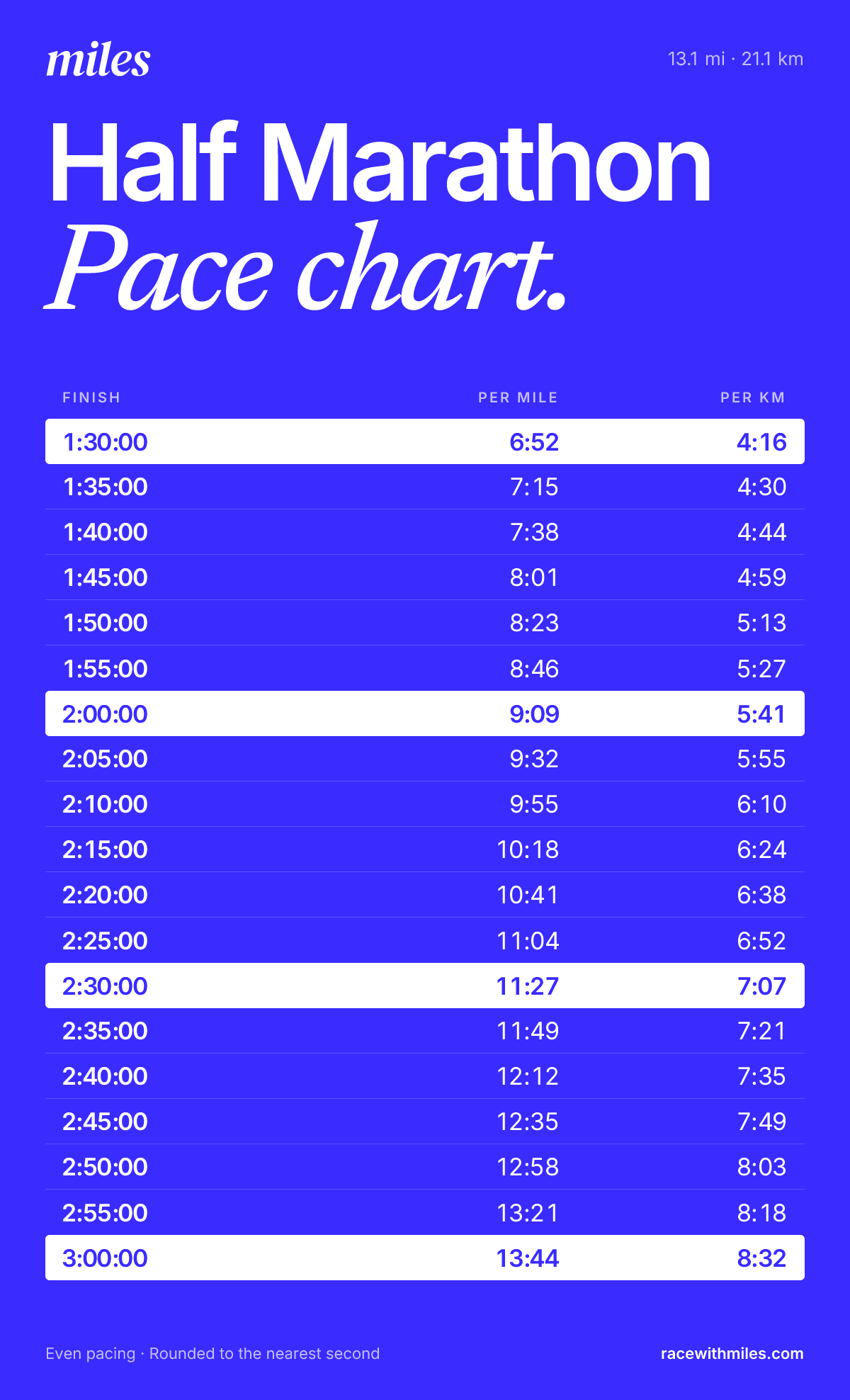
Save the full pace chart
Every goal from 1:30:00 to 3:00:00 in one image. Keep it on your phone or print it for a quick reference.
Download chart Open full-size imageBefore you head out
How to use this chart
Start with a half marathon goal that fits your training. Enter your finish time or pace to see what your watch should show at each checkpoint. Compare nearby paces to give yourself a few options, then save the plan to your phone.
A two-hour half marathon works out to about 5:41 per kilometer, or 9:09 per mile. At even pace, you’ll reach 10K in about 56:53. Treat that as a checkpoint, and check how the effort feels before deciding to pick it up.
A plan you can adjust
This chart shows even pacing: the same speed from start to finish. It gives you a reference for race day, but it doesn’t account for the course, the weather, or how you feel. Use it to guide your decisions as the race unfolds.
Questions runners ask.
Should I aim for even or negative splits in my half marathon?
On a fairly flat course, an even pace or a gentle negative split—running the second half a little faster—is a useful starting plan. Settle into a controlled effort early, then build if you still feel strong later. Avoid racing ahead of your target to bank time. This chart shows even splits; a negative split means being a little behind those checkpoints early and making up the difference gradually.
How should I adjust for hills or bad weather?
Keep the effort steady when the course or conditions change. Let your pace ease uphill or into a headwind, and don’t force yourself to win those seconds back immediately. Heat and humidity may call for a slower goal from the start. Compare a more comfortable pace here before you head to the start line.
What if my goal pace feels wrong on the day?
Give yourself time to settle in, then check your breathing, tension, and overall effort. If the pace already feels harder than it should for this stage of the race, ease back. If you feel great early, stay patient; you can build later when you know more about how the day is going.
What if I miss a split or fall behind?
One slow split doesn’t mean the plan is gone. A crowded start, a hill, or an aid station can all cost a little time. Return to a sustainable rhythm and look at the next few checkpoints together. Avoid a sudden surge just to make the watch match the chart.
Can I take this chart with me?
Yes. Tap Save card, then share or download the image to your phone. You can also open the image and take a screenshot. Once it’s saved, you can check it without a connection. Use Copy link if you’d like to come back and adjust your plan.
You’ve got a goal.Let’s help you get there.
Miles is a running coach wired directly into your training.